


about us
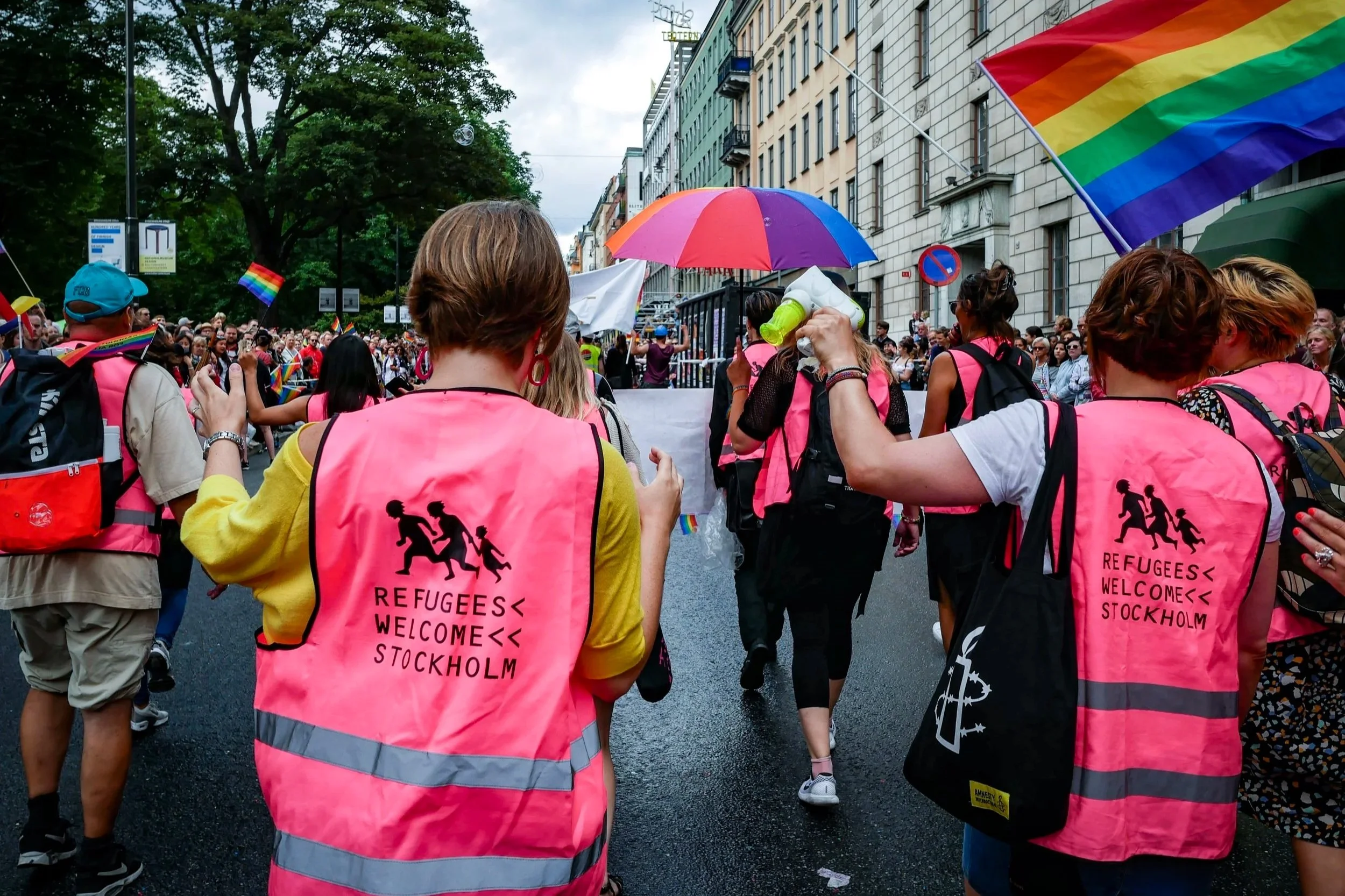
Refugees Welcome Stockholm is a religiously and politically independent organisation whose purpose is to help people with experience of forced displacement who come to Stockholm.
With support from individuals and companies, RWS works to give these people a dignified welcome and the help they need, both right now and in the longer term.
our history
In September 2015, people fleeing across Europe began arriving in Sweden and Stockholm. They had crossed country after country, border after border, on their way to the Nordic countries. Some reached their final destination in Sweden, while others were heading for Norway or Finland.
Under the Dublin Regulation, people without a residence permit must apply for asylum in the first EU country they arrive in. Most arrive first in Greece or Italy, but for various reasons travel on to other countries to register as asylum seekers there. In Sweden, the Migration Agency receives those who choose to seek asylum here, and under the Dublin Regulation no other category of refugee is supposed to exist. The so-called transit refugees who nevertheless came to Stockholm without seeking asylum therefore had nowhere to go while they waited for the next train north.
At the same time, large numbers of Stockholmers went to the Central Station to give everyone on the move a dignified welcome and see whether they could help in any way. Under the slogan “Refugees Welcome” they gathered food, blankets, tables and chairs and set up a makeshift reception centre. Doctors and nurses came and offered medical care to those who needed it. Volunteers brought child car seats and began offering lifts to and from the emergency short-term shelters set up in mosques, churches, schools, cultural centres and scout and community halls.
After a few days, as people kept arriving and the emergency shelters were filling up, even though most moved on quickly, the volunteers at the station agreed that they needed to open another shelter – this time with several hundred beds. Through contacts they gained access to a club venue at Nobelberget in Sickla, and the Refugees Welcome Stockholm movement was born.
The temporary transit shelter at Nobelberget stayed open for two weeks, during which around 1,700 volunteers worked together to provide more than 4,000 people with a place to sleep, food, medical care, clothes and legal advice. In the second week, the shelter could stay open thanks to the #ennatttill fundraising campaign on social media.
After the Nobelberget shelter closed, RWS continued the reception at Stockholm Central Station and ran a smaller shelter at Kvarnholmen in Nacka for two weeks in winter.
People's Campaign for the Right to Asylum
On 24 November 2015, the Swedish government presented measures that hit people fleeing war and persecution hard. Among other things, people without identity documents could not seek asylum, only temporary residence permits would be granted in Sweden, and separated families would find it much harder to reunite. The plan contained further points, summarised in a bill, all aimed at preventing or deterring refugees from coming to Sweden.
In response, RWS and several other organisations launched the People's Campaign for the Right to Asylum. Its aim was to bring together everyone who wanted to protest against the government's plans and stop the cuts. The campaign ran throughout the spring in traditional and social media, and when the petition was handed to decision-makers ahead of the parliamentary vote, 68,150 people had signed it. Even so, parliament voted for the bill on 21 June 2016.
inclusion activities
As fewer people with experience of forced displacement made it to Stockholm, Refugees Welcome Stockholm worked out how to support the people who were now here. In 2016 the Rosa Stationen inclusion programme opened at Birkagården, and in 2017 another opened at Midsommargården. Over the years two more programmes started, and the organisation has run four in total: Language Meetups & Legal Advice (2016–), Culture Sundays (2017–2022), the Frökodarna coding course (2018–2024) and the Creative Workshop (2022–2024).
the outbreak of war in ukraine
When the war broke out in Ukraine, Refugees Welcome Stockholm was quick to organise again. Within a few days the organisation had 4,500 registered volunteers, who for a month met the 300–700 people arriving every day on the ferries into Nynäshamn ferry terminal. RWS offered supplies to new arrivals, had interpreters on site, handed out information, and helped with transport and any other support people needed. RWS also opened clothing distributions, open four days a week for those who arrived.
how we work today
Today Refugees Welcome Stockholm focuses on three areas: advocacy for a stronger right to asylum, inclusion activities for people with experience of forced displacement, and emergency preparedness.
Rosa Stationen
Rosa Stationen is a meeting place where people come together regardless of status. Asylum seekers, newcomers, undocumented people, long-term residents and others of all ages and backgrounds take part. Here we meet and learn from each other. It is open to everyone – drop in whenever you like during the evening. We are open every Tuesday and, like all of RWS, have been run by volunteers since the start, people committed to a stronger and more inclusive welcome. You can read more about the programme today, and how you can get involved, under “Verksamhet” (What we do).
Advocacy
Alongside its emergency aid and meeting places, RWS has always worked actively to influence decision-makers and to change and improve the situation for people with experience of forced displacement. We constantly see the right to asylum under threat, and we use our voice in every way we can to draw attention to the injustices we see – on social media, in opinion pieces, at demonstrations and elsewhere.
Starting from the equal worth of every person, RWS sees a clear need for free and legal routes into Europe, and for a willingness as a state and nation to receive the people who come and to give them the conditions to find their place in society. Through social and traditional media and public debate, RWS raises these needs again and again.
EMERGENCY PREPAREDNESS
Part of RWS's emergency preparedness is being ready for situations when many people fleeing come to Stockholm. This means having strategies to organise quickly according to need, as the organisation did in 2015 and 2022. Another part is the organisation's emergency storeroom, which among other things supplies clothing distributions; we used to hold an annual winter clothing distribution. The organisation is currently reviewing how these can be structured and organised in future, and for now the storeroom only receives people who contact us with specific requests.
Contact us
Do you have thoughts or questions, or would you like to be part of RWS? Don't hesitate to get in touch using the form.